Criminal law journal

Img Heleno Fragoso Revistas

Criminal Law Journal

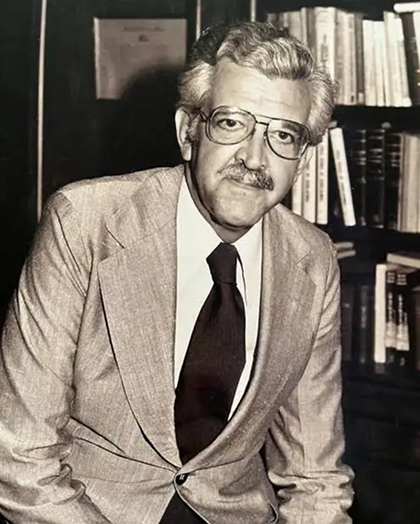
In 1963, Heleno Fragoso decided to resume the publication of the famous Brazilian Journal of Criminology and Criminal Law, from the Rio de Janeiro Law School, located in the traditional mansion on Catete Street, across from Artur Bernardes Street. For a few years, the Journal was directed by Prof. Roberto Lyra, who taught Criminal Law there.

In this new phase, Heleno managed to gather several articles from eminent Brazilian and foreign professors, such as Nelson Hungria, Basileu Garcia, Giuseppe Bettiol, Theodolindo Castiglione, and José Frederico Marques.

Full Professor at the Candido Mendes Law School, Heleno founded the Institute of Criminal Sciences. As of 1971, the institute began publishing, first through Editora Borsoi and later through Editora Revista dos Tribunais, the Criminal Law Journal, of which Heleno was the director from the beginning. The Institute of Criminal Sciences held numerous events in the city of Rio de Janeiro in the 1970s and 1980s, always under the direction of Heleno Fragoso, both in the auditoriums of the Candido Mendes College and at its own headquarters on Paulino Fernandes Street, in Botafogo.

Heleno managed to form and gather a range of young criminal lawyers, who met regularly at the Institute’s headquarters to debate topics relevant to criminal sciences and produce intellectual work to compose the Journal, published biannually. Later, given the importance of the integration between criminal-legal knowledge and criminological knowledge, the Journal was renamed starting from issue 32, becoming known as the Journal of Criminal Law and Criminology, published by Editora Forense.

After Heleno’s death in 1985, the 35th and final volume of the Journal was released. The complete collection of the publication is available here on the website. The institute was renamed the Heleno Fragoso Institute of Criminal Sciences, but the group dissolved, leaving a gap that, shortly after, was filled by the Brazilian Institute of Criminal Sciences (IBCCrim), headquartered in São Paulo.

Journal search
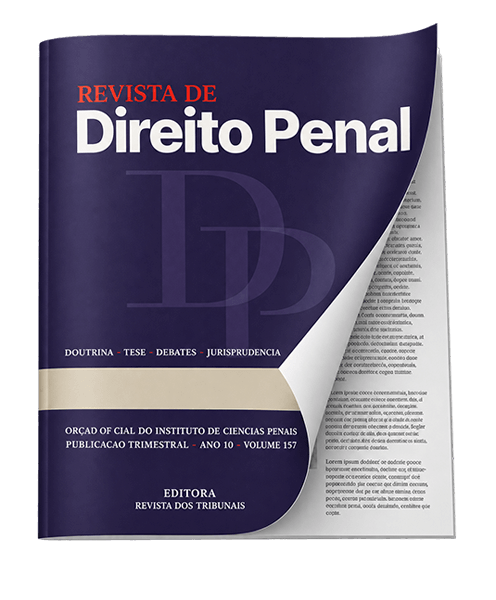
Revista Direito Penal

Criminal Law Journal Nº 01

Contributors: Alexandre Gabriel Gedey, Boaventura de Souza Santos, Fernando Fragoso, Heleno Claudio Fragoso, Mario Pisani, Roberto Lyra, Roberto Lyra Filho, W.H. Nagel
With the launch of this Journal, we seek to give expression and permanence to the remarkable work being carried out today in our country by those who dedicate themselves to the study of Criminal Law and its related sciences. It is unnecessary to emphasize what a publication of this nature signifies in terms of the effort and dedication of those who prepare its editorial content, as well as the bold commitment to, and confidence in, Brazilian culture on the part of those who resolved to undertake the responsibility of publishing it. The vicissitudes to which scientific publications are subject, often short-lived, are well known.

Our extensive and successful multi-year experience with the Revista Brasileira de Criminologia e Direito Penal, whose disappearance left a clear void against which legal scholars insistently protested, including at national congresses, convinced us not only of the imperative need for a publication of this nature, but also of its indisputable success, provided it meets the standards of scientific rigor that justify it. Furthermore, we present ourselves with the immediate assurance provided by a publishing house with the prestige and magnificent tradition of Editora Borsoi, thereby guaranteeing the success of this publication. It aims to fill the existing gap and remains open to all specialists. It will serve as the official organ of the Institute of Penal Sciences at the Cândido Mendes Law School, founded on our initiative with the invaluable and enthusiastic participation of esteemed colleagues, currently undertaking an intensive program of cultural activities that this Journal will amplify and preserve.

Striving to consistently maintain the study of key topics in our field at a high level by regularly publishing doctrinal contributions of great merit, this Journal aims to bring an academic perspective to the analysis and resolution of legal issues arising from the application of Criminal Law. We will place significant emphasis on the critical review of criminal jurisprudence, particularly from the Federal Supreme Court (STF), through both signed commentaries and reviews overseen by the editorial direction. We seek, in this way, to contribute to the refinement of our institutions and the enhancement of the administration of justice, without compromising our ongoing scientific and cultural commitments, including those related to the teaching of our discipline.

We will always remain faithful to the liberal traditions of our penal law, contributing to ensure that its scientific development, interpretation, and application align with the fundamental values of respect for human dignity and the basic principles of democratic legality.

We trust that the emerging figures who continually appear throughout the remarkable development of Brazilian legal culture, alongside the established masters to whom we owe so much, will assist us in carrying out this arduous task. The continuity of a publication such as this, given the high costs involved, will only be possible if we count on the support of professors, students, magistrates, members of the Public Prosecution, and lawyers, from whom we await the reward of recognition for the work accomplished.

In this issue, the reader will find high-level contributions in the doctrinal section. The excellent Roberto Lyra Filho, without a doubt the most remarkable university professor of his generation, writes on Criminology and Dialectics in honor of Hegel’s bicentennial. Master Roberto Lyra examines social literature and criminality, abandoning the perspective of universal literature—a topic addressed by many scholars (Alimena, Ferri, Quintano Ripollés, etc.)—to focus instead on Brazilian authors. Boaventura de Sousa Santos, assistant professor at the University of Coimbra—who recently visited our country and well represents, along with other esteemed colleagues, the new generation of Portuguese criminal law scholars—authors a top-tier study on political crimes and the death penalty, originally presented at the 1967 symposium celebrating the centenary of the abolition of the death penalty in Portugal. This study analyzes critical aspects of political crimes.

By Professor Mario Pisani, we publish Notes for the History of Motivation in Criminal Procedure, a valuable work—particularly for what it represents in terms of research into this important subject—in an exquisite translation by Professor Armida Bergamini Miotto.

The reader will also find in this issue the courageous presentation given by the eminent Professor Nagel on Critical Criminology at the 6th International Congress of Criminology, which was recently held in Madrid.

This section concludes with a work of our own authorship on the principle of legality (*princípio da reserva legal*), in which we examine its significance and scope from a modern perspective.

Other sections of this issue cover legal opinions, news updates, book reviews, and jurisprudence, the latter being extensively developed.

In our next issue, we will begin a series of publications on the new Brazilian Penal Code.

Heleno Cláudio Fragoso
Note: This text is an English translation of the original preface published in Portuguese in the Revista de Direito Penal.
read more
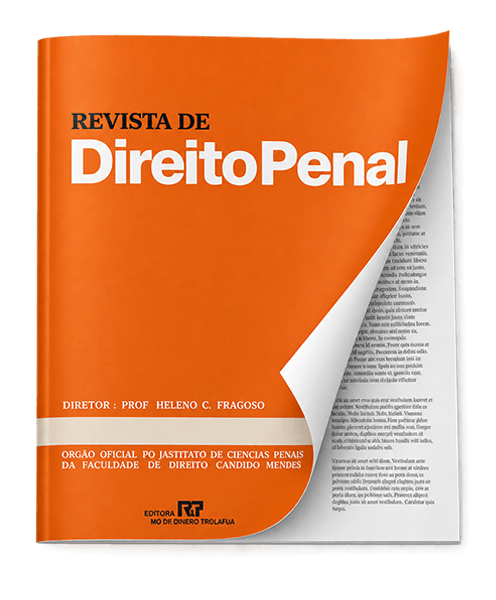
Revista Direito Penal

Criminal Law Journal Nº 02

Contributors: Eduardo Novoa Monreal, Heleno Claudio Fragoso, Nilo Batista, Roberto Lyra Filho
The extraordinary success that marked the launch of this journal, received with surprising enthusiasm, provides a clear indication of what it comes to represent on the cultural level in our country, and that in this sector there was, indeed, a void to be filled. In various locations, the issue sold out rapidly. We have received numerous communications filled with praise and encouragement from professors, magistrates, members of the Public Prosecution, and lawyers, and we wish to record here our gratitude, with the assurance that we will persevere in this undertaking without faltering.

In this issue, the reader will find three articles in the doctrinal section. The first, by Prof. Eduardo Novoa Monreal of the Faculty of Law at the Catholic University of Chile—an exceptional jurist who chaired his country’s Institute of Penal Sciences for many years and served as executive secretary of the Drafting Committee for the Model Penal Code for Latin America, which was established through his initiative. His work, “Human Progress and Criminal Law,” focuses on the impact of social transformations and technical progress on Criminal Law, referencing issues that are currently at the forefront of contemporary debate.

In this edition, we conclude Prof. Roberto Lyra Filho’s remarkable study, “Criminology and Dialectics,” in which the master examines in depth and with a sharp critical spirit the problems of Criminology, from a renewing philosophical perspective of exceptional value. Few in Brazil dedicate themselves seriously to the study of Criminology, which often falls prey to cultural charlatanism based on pseudo-science in an attempt at simplistic and superficial causalist exploitation. Prof. Lyra Filho’s study is one of those that sets the ground and marks the way, deserving, for that very reason, the indispensable attention of all scholars.

This section concludes with a legal study of our own authorship, “Aspects of the Theory of Offense Types” (*Aspectos da Teoria do Tipo*), in which we intend to examine and systematize several general categories of the Special Part.

In this issue, the reader will find our usual sections, with particular emphasis on the jurisprudence segment. Here, some of the most critical issues currently surrounding the practical application of our Criminal Law are examined in both depth and breadth.

Heleno Cláudio Fragoso
Note: This text is an English translation of the original preface published in Portuguese in the Revista de Direito Penal.
read more
Revista Direito Penal

Criminal Law Journal Nº 03

Contributors: Alexandre Gabriel Gedey, Arion Sayão Romita, Cesar Salgado, Diogo de Figueiredo Moreira Neto, Hans Welzel, Heleno Claudio Fragoso, Inocêncio M. Coelho, Lopo Alegria, Nilo Batista, Victor Nunes Leal
Although it was apparently in preparation for many years, little is known about the preparatory work and the process of discussion and approval of the new Penal Code’s text. In this issue, we begin the publication of an extensive work on the new Code, written by someone who took part in the task and who can, therefore, with authority, clarify facts and assign responsibilities.

We also include in this edition the remarkable work of Prof. Hans Welzel on negligence and traffic offenses (*a culpa e os delitos de circulação*), which constitutes one of the best doctrinal contributions to the study of negligent crimes. The text we publish is translated by Prof. Nilo Batista and contains additions and modifications sent to us by the author, thus constituting a revised version of his excellent paper delivered at the VIII International Congress of Criminal Law.

The reader will also find an opinion (*parecer*) by Justice Victor Nunes Leal on a much-debated issue concerning the crime of slander (*calúnia*), in which the author reveals his fine sensibility as a jurist, as well as several other articles in our Comments and Communications section. Here are works by Arion Sayão Romita on summary acquittal under the debated Law 4,611; by J. A. Cesar Salgado on the reform of the penitentiary system in Argentina; by Inocêncio M. Coelho on the scientific and philosophical work of Prof. Roberto Lyra Filho; and by Prof. Diogo de Figueiredo Moreira Neto on Brazilian administrative law regarding public safety.

In our next issue, which will complete our first successful year of publication, we will publish a comprehensive index of all subjects covered in these first four issues, including our jurisprudence section, thus enabling the binding of the volume.

Heleno Cláudio Fragoso.
Note: This text is an English translation of the original preface published in Portuguese in the Revista de Direito Penal.

read more
Revista Direito Penal

Criminal Law Journal Nº 04

Contributors: Alberto Rodrigues de Souza, Arminda Bergamini Miotto, Heleno Claudio Fragoso, José Carlos Barbosa Moreira, Manuel Lopez-Rey, Nilo Batista, Roberto Lyra, Sebastián Soler
With this issue, the Revista de Direito Penal completes its first successful year of publication, fulfilling the program it set out to accomplish. In order to facilitate the binding of the volume, a detailed alphabetical index covering all four issues of this first year was prepared, with particular emphasis on the jurisprudence section.

In this issue, the reader will find in the doctrinal section the notable study by Prof. Manuel López-Rey on criminology and criminal justice, which constitutes a sharp analysis of current problems concerning criminality, its suppression, and its corresponding study. Likewise, this edition includes another remarkable work by a great foreign master: the lecture by Prof. Sebastián Soler on the definition of criminal law. Master Soler is, without doubt, the most important figure among jurists in this part of the world, for whom we in Brazil hold the highest esteem. His work published here is the first lecture delivered by him in a cycle organized in November of this year by the Faculty of Law of the Federal University of Pelotas, transcribed directly from the tape recording. We hope to see published later this year, in Portuguese, the translation of his treatise, a task to which we have dedicated ourselves for a long time. We also include the highly fitting introduction of Prof. Soler given by Prof. Alberto Rodrigues de Souza, which presents an accurate profile of the Argentine master’s work and its exceptional significance.

By the excellent Prof. José Carlos Barbosa Moreira, we include a original work of the highest caliber on the criminal sentence as a civil enforcement title (*título executório civil*), in which key aspects of the subject are examined.

By Professor Armida Bergamini Miotto, we publish an exhaustive study on “Crime Prevention,” in which, as always, she demonstrates her expertise and consistently up-to-date knowledge.

Also included here are two legal opinions (*pareceres*) by Prof. Roberto Lyra, dealing with the issue of minority under the National Security Law and the elements of the crime of inducement to suicide.

Starting with this issue, the Jurisprudence Section adopts a new system of organization: strictly alphabetical, using a uniform abbreviation scheme, and grouping all material on a given subject under a single heading. This will make consultations much easier.

Starting with this issue, we inaugurate a new legislation section in which we will publish the complete text of all new criminal laws. Readers will thus be guaranteed comprehensive information regarding legislation in our field.

Heleno Cláudio Fragoso
Note: This text is an English translation of the original preface published in Portuguese in the Revista de Direito Penal.

read more
Revista Direito Penal

Criminal Law Journal Nº 05

Contributors: Albebaro Cavaleiro Macedo Klautau, Anibal Bruno, Enrique Cury, Heleno Claudio Fragoso, Nilo Batista, Roberto Lyra, Sebastián Soler
Continuing our dissemination of the lectures delivered by Prof. Sebastián Soler at the Faculty of Law of the Federal University of Pelotas, we publish the one titled “Grounds for Justification of Conduct,” in which the master presents us, with the vigor and insight that distinguish him, the general theory of grounds excluding unlawfulness. The text we print was transcribed directly from the recording and is published without revision by the author.

By Prof. Enrique Cury, who stands out among the new generation of Chilean criminal law scholars, we publish—from a philosophical perspective—observations on Culpability and Criminology.

In the doctrinal section, the reader will also find two other works, authored by those responsible for the publication of this journal, on the crime of homicide and on the crimes of insurrection and conspiracy. The work on homicide constitutes a chapter of the new edition of our long-out-of-print work on the Special Part, accompanied by an appendix on motor vehicle traffic offenses. Nilo Batista’s article offers an excellent contribution to the study of highly topical subjects, to which doctrine in our country has dedicated little attention.

Master Roberto Lyra is the author of two legal opinions (*pareceres*) dealing with subjects of particular interest: corporate criminal law and documentary forgery; and the criminal liability of the notary public.

The Institute of Penal Sciences, as part of the curriculum renewal program at the Cândido Mendes Law School, promoted the preparation of Criminal Law Notebooks (*Cadernos de Direito Penal*) to be used as working materials in classes and seminars. These notebooks were prepared by Prof. Aníbal Bruno and will be issued in an independent publication. In this issue, the reader will find the first of these notebooks, concerning the Theory of Criminal Law (*Teoria da Lei Penal*). In our upcoming issues, we will publish the continuation of the series.

Heleno Cláudio Fragoso
Note: This text is an English translation of the original preface published in Portuguese in the Revista de Direito Penal.

read more
Revista Direito Penal

Criminal Law Journal Nº 06

Contributors: Gilberto Macedo, Hans-Heinrich Jescheck, Heleno Claudio Fragoso, João Mestieri, Jorge Alberto Romeiro Junior, Juarez Tavares, Luiz Alberto Machado, Manoel Pedro Pimentel, Miguel Reale Junior, Nilo Batista, Raphael Cirigliano Filho, Roberto Lyra, Waldemir de Oliveira Lins
In this issue, we publish one of the most recent contributions by Prof. Hans-Heinrich Jescheck on International Criminal Law, a field in which he is undoubtedly one of the most prominent specialists today. His leadership of the Max Planck Institute in Freiburg im Breisgau and his manifold responsibilities in international associations enable the German master to offer us a broad and current perspective on the severe problems facing international criminal law.

In the Doctrinal section, additional works are featured, including one by the young professor Juarez Tavares, from Paraná—currently completing a fellowship at the Max Planck Institute, on intent (dolus) and other subjective elements of the offense, focusing on the subject through a modern lens; one by Professor Raphael Cirigliano Filho on putative crime; and an exhaustive analysis by Professor Manoel Pedro Pimentel on the offense and civil reparation in the Draft Civil Code.

In the Legal Opinions section, we have two pronouncements by the master Roberto Lyra: one on the crime of extortion under color of office (*concussão*) in ordinary law and Military Criminal Law; another on voluntary abandonment (*desistência voluntária*) in the crime of homicide.

Among the commentaries and communications, the reader will find studies by Waldemir de Oliveira Lins (on the role of the Public Prosecution Office in crime suppression); by Prof. Miguel Reale Júnior (on the ever-timely issue of drunk driving); by Prof. João Mestieri (on the directions of Criminology); and by Prof. Gilberto Macedo, on Criminal Sociology.

In addition to our regular sections, this issue also includes the full text of the Convention for the Suppression of Unlawful Seizure of Aircraft and Law No. 5,786 of June 27, 1972, which gave it effect, criminalizing acts that were previously unknown to our penal legislation.

read more
Revista Direito Penal

Criminal Law Journal Nº 07 e 08

Contributors: Antonio Evaristo de Morais Filho, Carlos de Araújo Lima, Evandro Lins e Silva, Heleno Claudio Fragoso, Ivo D´Aquino, José Frederico Marques, Luiz Alberto Machado, Nilo Batista, Roberto Lyra, Serrano Neves, Victor Nunes Leal
The publication of this journal was interrupted for some time due to reasons entirely beyond the control and will of its management. This was owed to financial difficulties that befell its former publisher in its business, ultimately leading to the cessation of its activities in that sector.

Starting with this issue, the Revista de Direito Penal will be published by Editora Revista dos Tribunais, which assumes responsibility for its publication, hereby guaranteeing the regularity of its release. Three double issues, containing an expanded number of pages, will be published immediately to cover the second half of 1972 and both halves of 1973, after which the journal will resume a strictly punctual quarterly publication schedule.

In this issue, we publish the extensive and meticulous study conducted by the Special Commission appointed by the Federal Council of the Brazilian Bar Association (OAB) on traffic offenses, along with the accompanying draft bill. It seemed important to us to immediately disseminate this work on one of the most difficult and complex problems, which in our country has reached the proportions of a genuine calamity. The study conducted by the Commission builds upon solid research into the subject, featuring a penetrating analysis and critique of current legislation. The draft bill prepared by the Commission (which Senator Nelson Carneiro presented to the Senate as a legislative bill) deserves the attention of all specialists.

In the doctrinal section, we also publish an excellent study by Prof. Luiz Alberto Machado on the state of necessity and the requirement of alternative conduct (*exigibilidade de outra conduta*). The author examines the subject with authority, taking into account the innovations introduced on the matter by the new Penal Code.

In this issue, we include three legal opinions (*pareceres*). By the master Roberto Lyra, on the crime of pledge fraud (*defraudação de penhor*); and by Justice Víctor Nunes Leal and Prof. José Frederico Marques, on the issue of jurisdiction for trying members of the Public Prosecution Office accused of crimes against the Union. The subject acquired great prominence in light of the omission in the Federal Constitution, which has now been addressed by ordinary law. The opinions examine the legal question in detail across its multiple aspects.

The case law of the Supreme Federal Court (STF) has already settled on the non-existence of an ex officio appeal (*recurso de ofício*) in crimes involving the trafficking and illegal possession of narcotics or substances capable of causing physical or psychological dependence. The issue, however, continues to be a subject of controversy. In this issue, we publish a work by the eminent Justice Evandro Lins e Silva on the matter, aligning with the jurisprudence of our Supreme Federal Court, which strikes us as beyond criticism.

In this issue, the reader will once again find the regular sections, including extensive news coverage and the case law review, presented in the style adopted by this journal. In the section on laws and draft bills, in addition to the previously mentioned OAB draft bill on traffic offenses, we include the Inter-American Convention on Extradition and the General Part of the Model Penal Code for Latin America (*Código Penal Tipo para a América Latina*). As is well known, the meetings of the Code’s Drafting Commission continue, currently examining the Special Part. However, the General Part of this ambitious project is already completed, having been approved at the plenary session held in São Paulo in 1971. The Portuguese text was prepared under the responsibility of Prof. João Bernardino Gonzaga.

Starting with the next issue of this journal, which will appear shortly, we will begin publishing all preparatory materials relating to the drafting of the new Penal Code, set to take effect on July 1, 1974. These are extremely important elements for the study and understanding of the new Code.

Heleno Cláudio Fragoso
Note: This text is an English translation of the original preface published in Portuguese in the Revista de Direito Penal.

read more
Revista Direito Penal

Criminal Law Journal Nº 09 e 10

Contributors: Heleno Claudio Fragoso, Laércio Pellegrino, Louk Hulsman, Luiz Alberto Machado, Manoel Pedro Pimentel, Nilo Batista, Sergio Demoro Hamilton, Yolanda Catão
Continuing with the editorial program established for this new phase, we publish a second double issue, which should promptly be followed by a third, so that this Journal may be brought up to date and transition to its regular quarterly publication schedule.

In this issue, we include a magnificent work by Professor L. H. C. Hulsman on decriminalization. This is the report presented by the eminent master at the Preparatory Colloquium of the XI International Congress of Penal Law, held in Bellagio in May 1973, concerning the first topic of this important conclave—the most suggestive and creative of them all. There is no doubt that the Criminal Law of our time faces a severe crisis stemming from the failure of classical means of penal repression, most notably custodial sentences, making a critical review of the entire theory of the legal consequences of crime imperative in order to adjust it to the demands of criminal policy. Along these lines (new methods and means), there emerges a need to revise criminalization criteria through a reexamination that ultimately touches upon the most critical problems of punitive law.

The doctrinal section also features two additional works. One, by the director of this journal, addresses Genocide—a topic included in the new Penal Code that must now be studied in Brazil from a technical-legal perspective, discarding the somewhat literary tone with which some studies approach it. By Prof. Nilo Batista, under the modest title “Notes on Permanent Deformity,” we publish an exceptionally sound study that thoroughly exhausts the subject.

In the Commentary and Communications section are two works. One, by Dr. Sérgio Demoro Hamilton—who is, without question, one of the most distinguished members of the Public Prosecution Office of Guanabara—on “The Adoption of the Principle of Mitigated Mandatory Prosecution in the Draft Code of Criminal Procedure”; and another by Dr. Laércio Pellegrino on Victimology, providing an accurate account of the 1st International Symposium on Victimology held in Jerusalem in September 1973, whose conclusions appear elsewhere in this issue.

In the regular sections, the reader will find important information, bibliographic reviews, and case law presented in the informative and critical style we have adopted. The bibliographic review section will be greatly expanded in our upcoming editions, providing complete critical information on all national publications in our field.

In the section on laws and draft bills, it is worth noting the publication—which we begin in this issue—of all materials relating to the drafting of the new Penal Code during this second and final (?) phase of its preparation. These are extremely important elements for the study of the new law.

Heleno Cláudio Fragoso
Note: This text is an English translation of the original preface published in Portuguese in the Revista de Direito Penal.

read more
Revista Direito Penal

Criminal Law Journall Nº 11 e 12

Contributors: Antônio Acir Breda, Claus Roxin, Enrique Cury, Fernando Fragoso, Heleno Claudio Fragoso
To the question of punishment—its foundations and limits—which today undeniably stands at the forefront of concerns for all Criminal Law scholars, we devote special emphasis in this issue, featuring two original works of the utmost importance and significance. The first is by Prof. CLAUS ROXIN, on culpability as a limiting criterion of punishment, in which the distinguished master from the University of Munich develops the core ideas that inspired the authors of the German Alternative Draft Penal Code on this matter. The second is by Prof. ENRIQUE CURY, of the Faculty of Law at the Catholic University of Chile—from whom we have previously published other works—demonstrating his refined sensitivity as a jurist in examining this grave problem. These papers were presented at the meeting organized by the Institute of Penal Sciences in Santiago, Chile, in April 1973, to debate the topic.

The doctrinal section concludes with a study by the director of this journal on incitement or assistance to suicide, reexamining and updating the subject from the perspective of the 1969 Penal Code—which no one knows when will enter into force.

In the Commentary and Communications section, we present an analysis conducted by Prof. ANTÔNIO ACIR BREDA, of the Faculty of Law at the University of Paraná, regarding the draft Code of Criminal Procedure. This study was prepared on behalf of the OAB (Paraná Chapter) and the Institute of Lawyers of Paraná, deserving the special attention of those tasked with revising the draft.

We call the reader’s attention to the extensive bibliographic review published in this issue. This is a section that will expand considerably in our upcoming issues, as accurate reporting and critical analysis of new specialized literature constitute a vital task of a scientific publication.

In the jurisprudence section are reports and commentary on several important decisions, highlighted by a note on “aggravated homicide, means and modes of execution” (which provides a comprehensive doctrinal and jurisprudential survey of the subject) and a note by Prof. NILO BATISTA on homicide committed against a sleeping person, featuring an exhaustive examination of the crime’s aggravating classification in such cases.

At the end, we publish the text of new criminal laws and decrees, as well as the Convention for the Suppression of Unlawful Acts Against the Safety of Civil Aviation, along with the respective decree ordering its execution and enforcement. This is the Montreal Convention (1971). We also publish the Statement of Reasons (*Exposição de Motivos*) and the ministerial bill amending the 1969 Penal Code, submitted to Congress by the government. This publication forms part of our plan to disseminate all preparatory materials for the new Penal Code—materials of great importance for its study and interpretation.

Starting with its next issue, as announced, this journal will resume its quarterly publication schedule.

Heleno Cláudio Fragoso
Note: This text is an English translation of the original preface published in Portuguese in the Revista de Direito Penal.

read more
Revista Direito Penal

Criminal Law Journal Nº 13 e 14

Contributors: Damásio Evangelista de Jesus, Everardo da Cunha Luna, Hans Welzel, Heleno Claudio Fragoso, Jackson Toby, João Mestieri, Jorge Alberto Romeiro, Luiz Alberto Machado, Manoel Pedro Pimentel, Marcelo Fortes Barbosa, Nilo Batista, René Ariel Dotti, Sergio Demoro Hamilton, Serrano Neves, Yolanda Catão
Access the edition's PDF

Access our entire content library

Sign up for our newsletter

Get our articles, news, and updates firsthand.

Contact us

Do you have any questions, requests, or want to speak with us?